Wardrobe planning
How to build a capsule wardrobe for Singapore
Start with the week you repeat, keep only pieces with several useful partners, and solve the wardrobe's bottlenecks before choosing another statement item.
By Pakai editorial · Updated · 9 min read
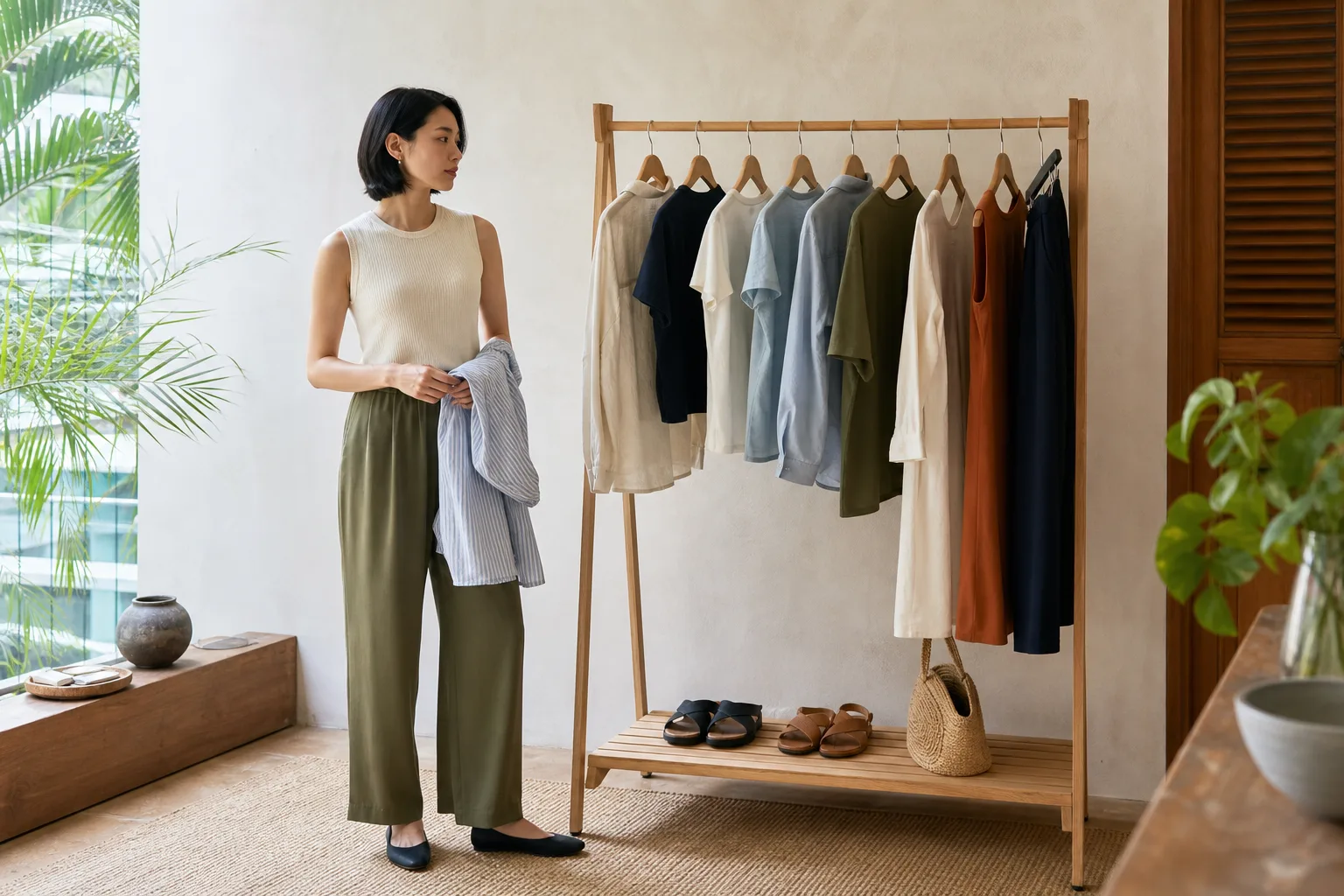
Keep these three ideas
- Build around the roles in your real week rather than a universal piece count.
- Require each core piece to make at least three useful outfits.
- Buy to solve a named wardrobe gap, then retest the whole system.
The short answer
A useful Singapore capsule wardrobe is a small set of clothes that covers your repeated work, casual, social, and occasion roles in warm humid weather. Start from outfits you already wear, not a universal list of essentials.
Keep core pieces that fit, feel comfortable, and combine into at least three real outfits. Use a restrained shared palette, two or three reliable silhouettes, practical shoes, and one removable indoor layer. Add only when you can name the gap the new piece will close.
Start with evidence
Count the roles in your actual month
Look back at four ordinary weeks and count workdays, casual days, exercise, social plans, ceremonies, travel, and anything with a specific dress code. The capsule should reflect that ratio. A person in uniform, a hybrid office worker, and a frequent event host do not need the same core.
Photograph the outfits you enjoyed wearing and note the pieces that caused friction. A capsule is not only a smaller wardrobe. It is a more legible system for the life already happening.
- Frequent role
- Give repeated work or casual days several interchangeable bases so laundry and weather do not break the system.
- Occasional role
- Keep one adaptable solution for dinners, interviews, or celebrations rather than several isolated outfits with no other use.
- Specialist role
- Sports, uniforms, safety clothing, and explicit ceremonial dress can sit outside the core. Do not force every necessary garment into the capsule arithmetic.
A practical starting structure
Choose partners before choosing a number
A starting edit might include four or five tops, three or four bottoms, one or two dresses or coordinated sets, one light indoor layer, and the shoes your repeated roles need. The right final count depends on laundry, dress codes, rewear comfort, and storage.
Choose a base neutral or two, a lighter bridge color, and one or two accents you already wear. Color is useful only when it increases combinations or gives the wardrobe a personal signal.
- Three-partner test
- Every core top should work with at least three bottoms or one-piece layers, and every bottom should work with at least three tops. Photograph the combinations.
- Two-shoe test
- Most everyday outfits should work with more than one pair so weather, walking, and recovery do not make the wardrobe fragile.
- Layer-off test
- The base outfit must remain complete when the air-conditioning layer comes off outdoors. Do not use the layer to hide a base that does not work.
Repeat the structure
Use a few silhouettes in many combinations
A capsule becomes easy when the proportions repeat. Pick formulas that suit your body and roles, then vary the color, texture, and level of polish.
- Defined top + fluid trouser + low shoe
- This can move from casual to office through the collar, material, and shoe. An overshirt adds indoor structure.
- Relaxed shirt + straight bottom + sandal or loafer
- Use a tuck, sleeve roll, or shorter hem to control the volume. The same shirt can layer over a simple dress or tank.
- One-piece base + removable layer + practical shoe
- A dress, jumpsuit, or coordinated set creates a fast complete line. The layer and shoe decide whether it reads as work, casual, or evening.
- Simple base + one accent piece + repeated color
- Let a rust top, striped shirt, or textured skirt provide personality, then echo one color elsewhere instead of adding several competing statements.
Make it work in Singapore
Plan for airflow, laundry, rain, and cold rooms
Singapore's warm, humid, rainy climate means a small wardrobe needs enough rotation for clothes and shoes to dry fully. Do not shrink the count so far that every base must be reworn before it is ready.
Choose shape, fabric behaviour, and friction points carefully. Keep one compact indoor layer, make sure hems can handle wet routes, and include shoes with different pressure points. A capsule should reduce daily effort, not turn every weather change into a failure.
Before buying
Name the broken outfit first
Write the exact gap before opening a shop: for example, a light trouser that works with four owned tops and survives the commute, or a meeting layer that fits over both dresses and shirts. A category name alone is not a useful gap.
When you try a candidate, test it with the actual partners. If it creates only one good outfit, needs another purchase, or duplicates a piece already doing the job, leave the gap open. The capsule improves through solved constraints, not a lower item count on paper.
- Replace before expanding
- When a core piece is worn out, look for a better version of the same job before inventing a new category.
- Use a waiting list
- Keep the named gap for two weeks and note every time it blocks an outfit. Repeated evidence is a stronger buying signal than a single difficult morning.
- Retest after every addition
- A useful new piece should increase combinations or remove friction. Photograph the new formulas and release a duplicate when the role is now covered.
Browse the building blocks
- Browse topsFill a named base, collar, or color gap.
- Browse pantsChoose a high-frequency bottom with several partners.
- Browse skirtsAdd a useful silhouette only when it multiplies outfits.
- Browse setsUse coordinated pieces together and separately.
- Browse dressesFind a one-piece base that serves several roles.
Sources and review
Turn the guide into your outfit
Pak will ask about the details that matter, then build the full look.
Build my capsule wardrobe